I write, erase, rewrite, erase again, and then a poppy blooms.
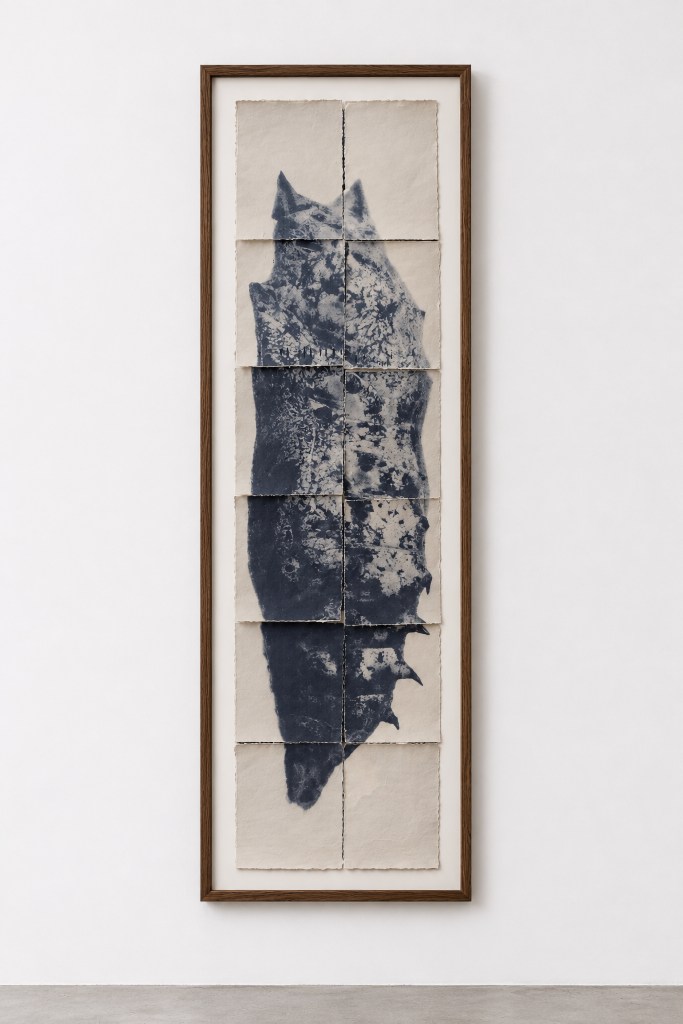
Dear chrysalis, am I still dreaming?
ink on Washi, 180.00 × 42.00 cm
Dear Chrysalis, am I still dreaming? is a series of six prints, each measuring 180 × 42 cm, produced on thin Okawara washi paper. The work is a culmination of investigations and experiments which have redirected the artists practice into new ways of working and producing. The series is an exploration of transformation as both a physical and psychological condition, considering the relationship between internal and external worlds, the instability of identity, and the ways in which experience shapes our understanding of ourselves and our surroundings.
Beginnings are found in the collection of discarded chrysalis shells: the fragile, empty structures left behind after a butterfly has emerged. These remnants are photographed and digitally printed onto handmade paper before undergoing a process of deconstruction and reconstruction through collage. The original photographic images are fragmented, torn apart and reassembled, creating layered compositions in which individual pieces of paper form new, disrupted representations of the chrysalis. Multiple viewpoints coexist within a single image, unsettling the idea of a fixed perspective and allowing the subject to appear simultaneously familiar and unfamiliar. The resulting compositions occupy a space between documentation and abstraction, preservation and destruction, where the image is continuously transformed through the physical act of making.
The chrysalis becomes a metaphor for the complex and often imperceptible processes of change that take place within us. Although transformation is commonly understood as a movement towards a new state of being, it is rarely linear or clearly defined. It involves periods of uncertainty, vulnerability and disorientation, during which previous understandings of the self begin to dissolve without the certainty of what might emerge in their place. The discarded shells embody this paradox: they are evidence of a transformation that has already occurred, yet they retain the physical impression of a former existence. They suggest a longing for something that has been left behind, while simultaneously pointing towards the possibility of becoming something else.
The title draws upon the philosophical uncertainty expressed in Zhuangzi’s The Butterfly Dream, in which the distinction between a man dreaming he is a butterfly and a butterfly dreaming it is a man becomes impossible to establish. This questioning of identity and reality provides a framework for considering the boundaries between the self and the world, between what is experienced and what is perceived, and between the observer and the observed. The question of whether one is awake or dreaming becomes a broader meditation on the instability of knowledge and the impossibility of fully separating internal experience from external reality.
The works also consider how we construct an understanding of ourselves through encounters with the world. Knowledge is not simply accumulated as a fixed body of information, but continually acquired, questioned and reorganised through experience. In this sense, the process of making mirrors an internal process of assimilation: gathering fragments from the outside world, absorbing them, and allowing them to alter existing structures of thought. The photographic image initially acts as a form of empirical observation, an attempt to document and understand something tangible. Yet, through fragmentation and collage, this information is disrupted and reconfigured, suggesting that perception is never entirely objective. What we see is inevitably filtered through memory, emotion and previous experience.
The torn surfaces of the works reflect this ongoing negotiation between inside and outside. Each fragment retains traces of its original image while becoming part of a different whole, much like experiences that remain embedded within us even as our understanding of them changes. The delicate washi paper further emphasises this sense of fragility, holding together structures that are at once broken and renewed.
Ultimately, Dear Chrysalis, am I still dreaming? considers transformation not as a final destination, but as a continuous state of becoming. It reflects upon the longing for home and belonging, the uncertainty of change, and the possibility that the self is never entirely separate from the experiences that shape it. Like the chrysalis shell, we carry the remnants of previous versions of ourselves, even as we move towards an existence we cannot yet fully recognise. Between dreaming and waking, knowing and questioning, the works inhabit this uncertain space of transition, asking whether transformation is something we undergo, or something through which we continually come to understand who we are.
Dear chrysalis, am I still dreaming? is a work currently in its final stages and will be released for online viewing from 1st January 2027.
Studio visits and public viewing are welcomed by prospective galleries, museums, and institutional representatives. For queries or interest, please get in touch via email.
Copyright 2016 – ∞. All rights reserved.
